If you’re a fan of all things horror, you’ll be pleased to find a culture that embraces the genre more fiercely than many other nations. This is largely due to Japan being quicker to accept animation and comics as media for all ages, not just children. Plus, the supernatural and superstition are deeply rooted in the country’s cultural identity. As a result, there is a wide variety of anxiety-inducing horror anime. If you’re just getting into the world of horror anime or planning a revisit, here are some of our favorites.
What are the best Horror Anime as of 2026?
Despite having some of the best horror manga out there, anime can have a harder time reaching its audience. This is somewhat of a letdown, considering some of the most horrific, terrifying creatures in fiction are found in Japanese folklore. Maybe it’s expecting too little of its audience, but a lot of horror anime leans into comedy as soon as it gets too scary. Still, there’s plenty of great horror anime out there.
Belladonna of Sadness (1973)
Jeanne and Jean are peasants in medieval France. They are also madly in love. Unfortunately, the local baron is a deep believer in the old custom of droit du seigneur. He also shares Jeanne with his court, an experience that traumatizes both Jean and Jeanne.
When Jeanne starts to have visions of a mysterious figure offering her power for revenge afterward, she is ready to take it. Thus begins a one-woman war on the wicked baron, as Jeanne slowly sells her soul for magical secrets. Unfortunately, her efforts ultimately cost her everything she had hoped for as she sought justice.
The third of a trilogy of historic anime aimed at adults, Belladonna of Sadness was a bomb upon release. However, it later developed a cult following and came to be considered the finest of the early works of director Eiichi Yamamoto. It is praised for its unique visual style, which mixes slowly animated watercolors with psychedelic imagery. It is also noted for offering an examination of violence against women and the struggle for bodily autonomy, which was rare for the time in Japan.
Akira (1988)
The year is 2019, and the world has been warped by nuclear war. Tokyo was destroyed, leading to the construction of Neo-Tokyo. Unfortunately, the problems of the old world remain, with terrorism and gang violence on the rise in the face of rampant government corruption.
It is on this stage that teenager Tetsuo Shima is forever changed. After a motorcycle accident in which he collides with an escaped government test subject, Tetsuo develops amazing psychic powers. He then becomes a threat not only to the new government of Neo-Tokyo but to the entire world.
Some debate whether Akira qualifies as a horror movie. The arguments against it are similar to those against labeling Alien as a horror movie purely because of the science fiction setting. Most anime fans, however, agree that Akira offers some of the most striking images of body horror in animated history. Indeed, these visuals later inspired more traditional horror anime, and while often imitated, are rarely equaled. In any case, it is considered by most to be the magnum opus of director Katsuhiro Otomo.
Perfect Blue (1997)
Mima Kirigo is one of the most popular J-Pop singers in Japan. However, she has dreams of becoming a serious actress. The announcement of her retirement from the idol scene upsets many fans. Chief among them is Me-Mania, an obsessive fan who starts stalking Mima and posting her comings and goings online.
Soon, Mima’s career is threatened by a series of murders. Worse yet, she starts having blackouts that point the finger of suspicion at her. This leaves her questioning both reality and her very identity.
Perfect Blue was the directorial debut of Satoshi Kon, and it is still considered one of his best works. It is remembered today for its eerily prescient take on pop culture in the age of reality TV. Beyond the use of technology and the stalking themes, however, there is a deeper level of psychological horror. This multifaceted approach invites comparison to the work of Alfred Hitchcock.
Vampire Hunter D: Bloodlust (2000)
D is a dhampir, a half-human, half-vampire, who uses his powers to fight the forces of darkness. He does not do this for free, however, and must be contracted like any other mercenary. This leads him to be hired by a man to rescue his daughter, Charlotte, from the vampire Baron Meire Link.
Unfortunately for D the job quickly becomes more complicated. First, because Charlotte’s brother contracted the Marcus Brothers to undertake the same mission. Next, because Charlotte is not truly a captive, and apparently fell in love with the Baron. This leaves D struggling to uncover the truth while battling his rivals and his own dark urges.
Vampire Hunter D: Bloodlust is the second film inspired by a long-running series of horror novels by Hideyuki Kikuchi. While the original 1985 Vampire Hunter D is considered a classic, Vampire Hunter D: Bloodlust enjoys a stronger reputation among horror fans. This is largely due to the direction of Yoshiaki Kawajiri, who improved on the pacing and world-building of the first movie.
Another factor is the unique dystopian setting. This adds another level to the usual themes of vampire horror. The decay and ennui of the undead existence are reflected in the slowly dying world, presenting existential horror alongside the bloody violence.
Goblin’s Box (Mouryou no Hako) (2008)
Directed by Ryūtarō Nakamura and produced by Madhouse, the Goblin’s Box is a 13-episode series based on the novels by Natsuhiko Kyogoku. However, it is important to note that the translation for Mouryou, which roughly means Goblin, isn’t exactly Goblin as we think of it, as in little troll creatures. So don’t come in expecting goblins. Some of you might not be into goblins, but just note that there really aren’t any goblins here. But there is evil in various forms.
The story centers on a series of gruesome, seemingly unconnected murders that begin to shake postwar Japan. Each involved dismembered bodies packed into identical wooden boxes. At the center of the investigation are a journalist pulled into the case and a detective with an obsessive need for order. Add to that mix a cast of occult researchers who believe something far older and stranger may be at work beneath the surface of the crimes. From animation to sound to story, this ranks high on our favorites. Though technically considered horror, this is far more disturbing on a psychological level. It’s not graphic, but nevertheless deeply uncomfortable.
Shiki (2010)
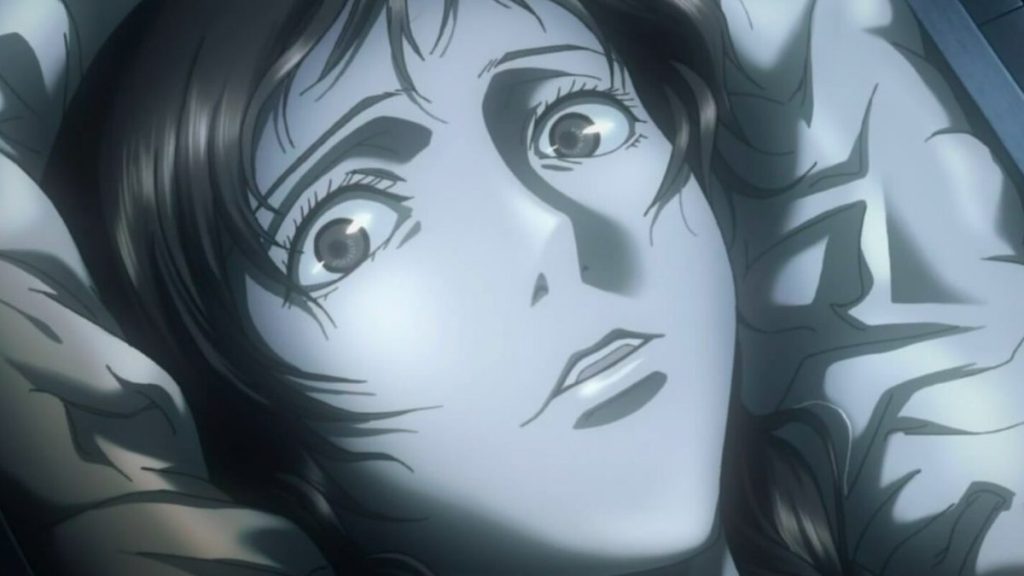
The story sinks its teeth into you and isn’t one to let go. This might be one of the creepiest horror anime series out there; there are more than a few moments you’ll find yourself watching through your fingers. Even if you just take a look at stills from the series, you’ll know what we’re talking about. The story takes us to a village where the townspeople start dying off. But these corpses don’t stay buried long, as they begin to rise from the grave, attacking their loved ones. If you’re a fan of Stephen King, and Salem’s Lot in particular, this might be up your alley. And even if you’re not, but you’re a fan of all things horror and have a deep appreciation for the art of anime, odds are you’ll have a good time with this, too. The art here is astonishing, and this series somehow flies under the radar of horror anime too often.
Gyo: Tokyo Fish Attack (2012)
A young couple, Tadashi and Kaori, had planned a wonderful scuba-diving vacation in Okinawa. Kaori was less thrilled than her boyfriend, however, due to her powerful sense of smell and the ever-present scent of rotting fish. And that is before they encounter the oddity of a fish with robotic legs.
Soon, all of Okinawa is under siege by the piscine menace, including a great white shark. This is all revealed to be part of a byproduct of several ill-advised Japanese experiments in biological warfare from World War II. The end result is a menace that is as deadly as it is ludicrous.
Based on a manga by legendary horror creator Junji Ito, Gyo: Tokyo Fish Attack may be his single strangest work. However, the silliness of its premise does not minimize how horrific it ultimately is. Beyond the ridiculous image of aquatic creatures with robot legs, there is the equally ridiculous explanation of how they developed those legs in the first place.
Director Takayuki Hirao does a masterful job in adapting Ito’s visual style. Gyo is absurdism in action, forcing the audience to laugh so they do not cry at the characters’ torment. By the time it becomes apparent just how serious the threat is, the audience is deeply invested in the characters and their tribulations.
Yamishibai: Theatre of Darkness (2013)
This one veers into creepy ghost-story territory, akin to Are You Afraid of the Dark? That show was aimed at kids and teens, but those episodes still hold up as terrifying. Similarly, some episodes of these are somewhat silly, and some will keep you up at night. All of them, however, are beautifully told through their animation style, which mimics kamishibai paper theatre. Every episode, each with a short runtime of under 5 minutes, a man in a raincoat arrives at dusk and tells a terrifying tale, each more disturbing than the last.
If you’re interested in more anime rooted in Japanese ghost stories and folklore, it’s also worth checking out Ayakashi: Samurai Horror Tales as well as Requiem from the Darkness, also known as Kyogoku Natsuhiko: Kousetsu Hyaku Monogatari.
Parastye: The Maxim (2014)
You’ll find this title time and time again, but that’s because it’s genuinely fantastic. Based on the horror manga by Hitoshi Iwaaki, Parasyte: The Maxim features an ordinary high schooler named Shinichi Izumi living in Japan as strange parasitic creatures descend on humanity. These alien organisms burrow into human hosts and begin taking over their brains and bodies completely. The effect is gnarly and starts to turn humans into cannibalistic creatures. Shinichi barely avoids that particular fate when one of the parasites fails to reach his brain and instead takes control of only his right hand. The creature, eventually named Migi, and Shinichi end up in an uneasy partnership. Together, the odd couple hides their condition from society and battles other parasites feeding on the humans around them. Expect plenty of body horror imagery with this one, though it stays somewhat tame and lends itself to the odd horror of Beetlejuice mixed with anime animation.
Uzumaki (2024)
Adapted from the manga by Junji Ito, Uzumaki is a perfect deluge of unsettling visuals that tap into the body-horror subgenre. There’s not a lot of gore or horror at work, but the textural elements are uncomfortable. The mini-series is as weird as it comes, and it’s a trip to watch. It’s also one of the few adaptations of Junji’s work. The plot is fairly strange in that a town is cursed by a supernatural plague of spirals, which ultimately begins to distort reality and the physical world, including people’s bodies. There’s a lot to be said of the manga itself, which easily makes the best horror manga list. The source material is great, but the quality of the anime adaptation earns it a place on our list. It’s a fantastic adaptation, in that the viewing experience closely mirrors the reading experience in style and texture. It’s truly the manga brought to life. This one is a visual feast, to put it lightly.
How we picked the best Horror Anime
Horror is a diverse genre with several subgenres. While some fans embrace all forms of frightening film, others are more selective. Some like a little bit of comedy mixed in with the scares. Others prefer psychological torment to blood and gore.
With that in mind, we compiled a brief list to highlight the sheer variety of horror anime over time. We wished to avoid leaning too heavily on any one subgenre over another. An effort was also made to list one film per director to avoid undue bias. (Otherwise, we might have a list made entirely of Yoshiaki Kawajiri movies.)