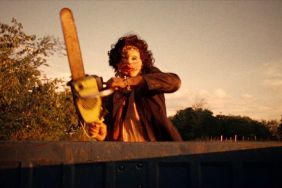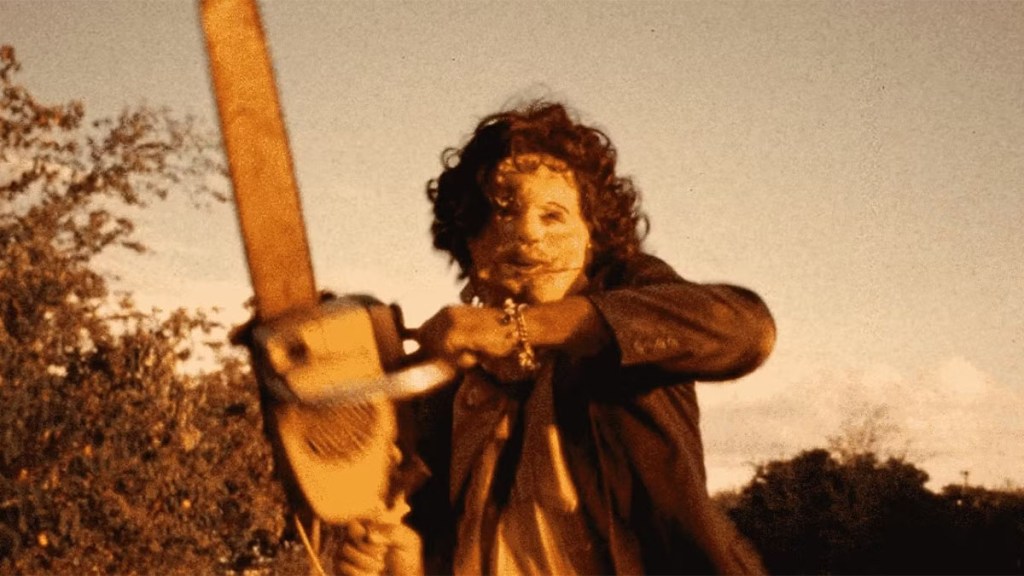
Maybe Ryan Murphy’s latest season of Monster on Netflix has made you think, “Wait, this whole wearing-the-skin-of-dead-people thing feels a lot like Leatherface from The Texas Chainsaw Massacre movies.” And you’d be right. Filmmakers have long taken “inspiration” (if that’s even the right word) from real-life serial killers. In this case, Leatherface was partially inspired by the infamous Ed Gein himself.
Whatever brought you here — curiosity, nostalgia, or the craving for a good old-fashioned horror marathon — you’re in the right place. Here are our picks for the best Texas Chainsaw Massacre movies.
What are the best Texas Chainsaw Massacre movies?
When The Texas Chainsaw Massacre first hit screens in 1974, it redefined horror and set the stage for the modern slasher era. Not every sequel or reboot has managed to capture the original’s strengths. However, there are still plenty worth watching, especially if you’re gearing up for a Halloween season filled with screams, chainsaws in corn mazes, and questionable dinner invitations.
Before we get into our top picks, fair warning: these films are not for the faint of heart. They’re brutal and unapologetically violent. Also, as a note, this list isn’t ranked. The only one that really matters, if you’re asking us honestly, is the original.
The Texas Chainsaw Massacre (1974)
When The Texas Chainsaw Massacre premiered on October 11, 1974, audiences and critics didn’t know what to do with it. An incredibly polarizing film, it has since gone down as a cornerstone of horror history. Made by two independent filmmakers, Tobe Hooper and Kim Henkel, on a budget of $140,000 (roughly $700,000 today), no one could have expected it to earn more than $30 million. Shot in central Texas with a mostly unknown cast, the production faced major struggles, from brutal filming conditions to trouble finding a distributor. But against all odds, The Texas Chainsaw Massacre became the most commercially successful horror film since The Exorcist, and holds its reputation for being one of the most influential horror movies ever made.
For those who haven’t seen it, The Texas Chainsaw Massacre follows a group of friends on a road trip through rural Texas. Things start to go south (in terms of luck, not geographical location), and they stumble upon a decaying farmhouse. One by one, they’re separated, captured, and completely brutalized by Leatherface and his freaky cannibalistic family. Hooper famously tried to limit the film’s on-screen gore in hopes of securing a PG rating (how he ever thought that was possible is anyone’s guess), but it still ultimately landed an R rating. Beyond its horror roots and the obvious nods to real-life serial killers, Tobe Hooper also drew inspiration from the shifting cultural and political climate of the 1970s.
The Texas Chainsaw Massacre 2 (1986)
After the shocking success of the original, it’s surprising it took twelve years for a sequel to finally happen. The Texas Chainsaw Massacre 2 went into production after the first film’s theatrical re-release in 1981, which helped put Leatherface and his family back into the horror spotlight. With the first movie, director Tobe Hooper felt audiences had somehow missed the humor. With the sequel, he opted to lean into it with a heavy hand. The result is a movie that is really weird in its over-the-top screams and buffoonery, plus some incredibly ridiculous plot elements. Not all of it works, and the result left audiences and critics with mixed responses.
The sequel follows radio DJ “Stretch” Brock (Caroline Williams), who accidentally records a brutal chainsaw murder live on air. The broadcast draws the attention of the Sawyer family, who track Stretch down at the radio station. Meanwhile, ex–Texas Ranger Lefty Enright (a gloriously unhinged Dennis Hopper) has been hunting the cannibal clan for years, after his niece and nephew were killed in the first movie. If you can manage to stick around long enough, the movie will lead to an explosive ending.
Texas Chainsaw Massacre: The Next Generation (1995)
It’s hard to remember a time before Matthew McConaughey and Renée Zellweger were A-listers. But once upon a time, they were just a couple of recent actors fresh out of the University of Texas at Austin, trying to add student film and indie credits to their résumés. Zellweger did have a small role in Reality Bites, but for the most part, both leads were still unknown when the movie went into production. Though it’s hard to call this movie good, it’s the actor’s performances alone that earn it a spot. It’s easy to see why McConaughey and Zellweger weren’t going to stay unknown for long.
Initially titled The Return of the Texas Chainsaw Massacre, the fourth film in the franchise was later rebranded and re-released as The Next Generation to cash in on McConaughey and Zellweger’s newfound fame. The movie follows Jenny (Zellweger), a high school student who, along with a few friends, ends up stranded in rural Texas on prom night. When they stumble on the wrong house, they’re soon hunted by a new generation of the Sawyer family, including McConaughey as the deranged Vilmer. It’s exceptionally strange to say, but the guy’s still got charisma.
Leatherface: Texas Chainsaw Massacre III (1990)
If The Next Generation gave us McConaughey and Zellweger, Leatherface: The Texas Chainsaw Massacre III introduced us to a young Viggo Mortensen as the deranged but oddly charming Tex. Charming as in Southern, sometimes polite, but completely psychotic. New Line Cinema purchased the film’s rights and took things in a much grittier approach than its predecessor. This time, the Sawyer family isn’t portrayed as buffoonish or cartoonish — they’re disturbingly ordinary in every way except for the killing, mutilation, cannibalism, and tendency to decorate with human skin.
The production was notoriously challenging in nearly every element of production. The studio fired director Jeff Burr at one point, and then rehired him when they couldn’t find another director. The movie, unsurprisingly, tells the story of a young couple who experience bad luck: their car breaks down, and they are tracked by Leatherface and his family. Though it was intended to be the goriest entry in the series, heavy censorship from the MPAA forced the studio to cut nearly four minutes of intense violence before the film’s release.
The Texas Chainsaw Massacre (2003)
The early 2000s were the era of the horror remake. After the success of The Texas Chainsaw Massacre reboot, the moviemaking floodgates opened — Dawn of the Dead (2004), The Amityville Horror (2005), House of Wax (2005), The Wicker Man (2006), and Halloween (2007) all followed. Did any of these movies actually need to be remade? Probably not. But some of you might remember Friday nights at Blockbuster, scanning the horror aisle, trying to find the scariest DVD for the weekend.
The 2003 Texas Chainsaw Massacre reboot keeps the bones of the original story but adds a meaner layer of early-2000s horror grime. It was produced by Michael Bay’s Platinum Dunes (which should tell you everything you need to know about the tone), and surprisingly, some of the original crew came back, including cinematographer Daniel Pearl. He’d shot the 1974 version and decided to go in the complete opposite direction visually this time: less documentary-style grit, more cinematic dread.
Set in 1973, the film follows a group of friends traveling through rural Texas who pick up a hitchhiker, which, as we all know by now, doesn’t end well. They end up at a farmhouse and come face-to-face with Leatherface (Andrew Bryniarski) and his deeply disturbed family. Jessica Biel leads the cast as Erin, a significant pivot from her time on 7th Heaven.
How we picked the best Texas Chainsaw Massacre movies
The term “best” is admittedly subjective, and in the case of The Texas Chainsaw Massacre franchise, perhaps even debatable. Ask any fan, and get different opinions. But it’s hard even to pick the best Texas Chainsaw Massacre movies when most of them sit below 30% on Rotten Tomatoes. Aside from the original film and the sequel, the ratings are at 84% and 50%, respectively.
So, in addition to the original 1974 and its 1986 sequel, we included the later installments that are worth watching for the performances from some of our favorite actors early in their careers. We added the 2003 remake due to its importance in reigniting mainstream interest in horror, effectively setting off the wave of early-2000s reboots that followed.